At a trade show, the internet is the one thing you can’t control. AVIXA TV has built a broadcast operation that doesn’t need to.
Who They Are
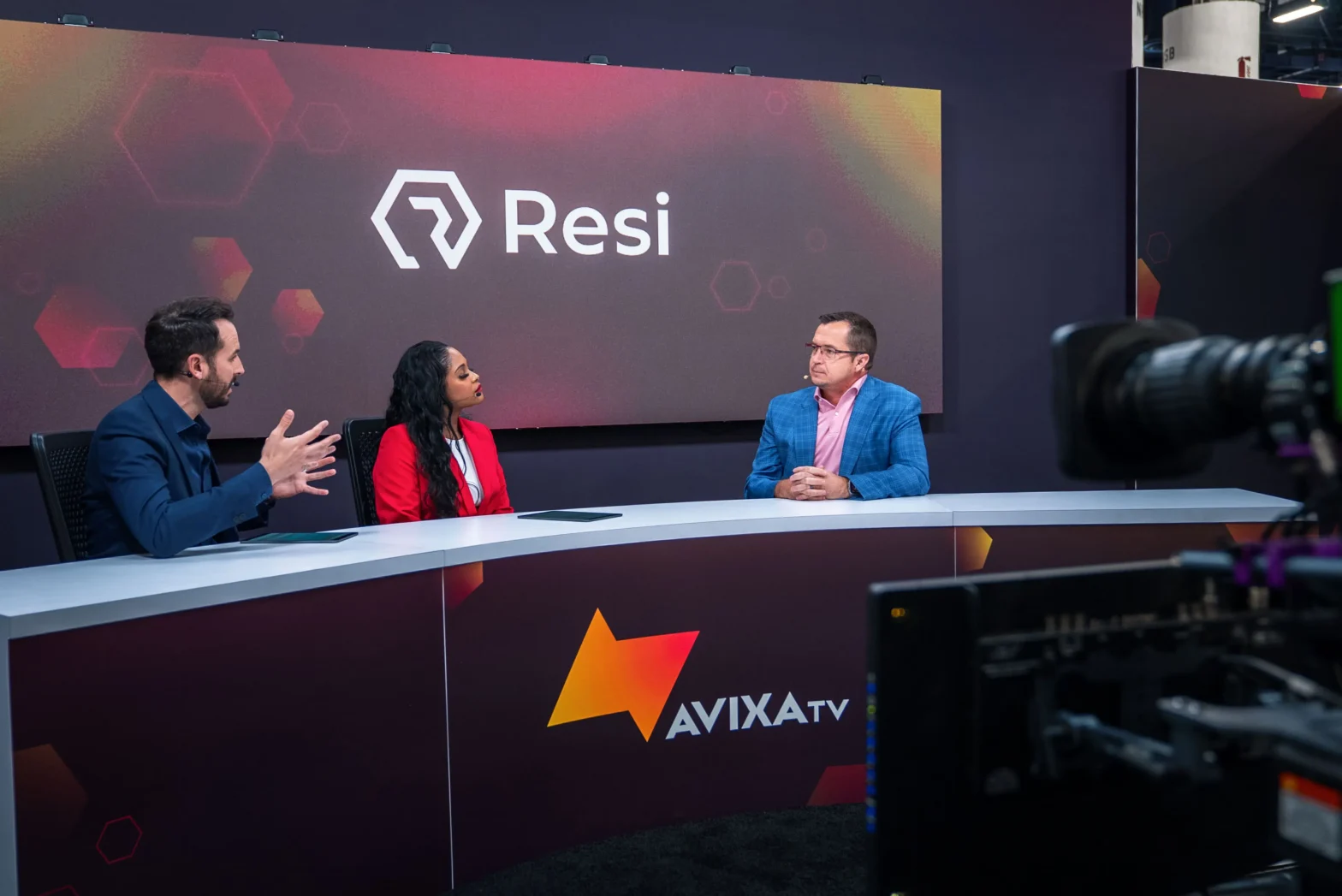
AVIXA TV is the broadcast arm of AVIXA, the trade association behind InfoComm and ISE — two of the largest AV industry trade shows in the world. What started as a scrappy, low-budget operation has grown into a full-scale production team that builds a live TV studio on the show floor at every major event, and now runs a permanent studio out of AVIXA’s headquarters in Virginia.
“Back when AVIXA TV first started, our requirements weren’t as high,” said Narin Nara, Digital Media Producer at AVIXA. The team was using a solution that, in his words, “was not a professional broadcast solution.” As the studio grew — from what he describes as starting “in a closet” to a full production presence at shows on multiple continents — the requirements grew with it. “As we grew, we needed something more professional,” he said.
That growth is now company-wide. Sam Minish, AVIXA’s Vice President of Content Delivery, oversees the studio’s overall operation. Mark Metzger, Senior Digital Video Manager, runs the day-to-day content and engagement strategy. Carey Johnson, Digital Content Operations Manager, keeps the show floor build running. And AVIXA works alongside multiple technology partners to pull it off — including Ross Video, which supplies the back-end studio hardware. “Ross works hand in hand with the other partners to make the TV studio live at the show,” said Matt Morgan of Ross Video.
The Challenge
Running a broadcast studio inside a convention center means giving up almost everything a studio normally controls. “Everything that you would do in a normal studio environment — controlling the sound, having access to higher bandwidth and speeds — all of that kind of goes out the window at a trade show,” Metzger said. “We have wireless interference, we can’t control the lighting all the time because it’s everywhere, we can’t control the sound because we have other booths and things happening. It is an extremely chaotic, complex environment.”
Bandwidth is the biggest variable of all. Every exhibitor on the floor is competing for the same network, and AVIXA has had to distribute a broadcast-quality stream on connections as thin as five megabits or less. Before working with Resi, the team relied on another streaming platform, and the show floor made that exposure obvious. “We had challenges — on the show floor, a couple of times the signal would just drop,” Metzger said. “We’d sometimes have to run a backup, like a laptop, other things to make sure that stream stayed up.”
Carey Johnson put it in operational terms: as a leader building a team on-site, “I have to be sure that I can trust who I’m working with — that they know exactly what they’re doing and can get the job done.” For AVIXA, the technology was only half the problem. The other half was finding a partner who would actually show up when things went wrong.
The Solution
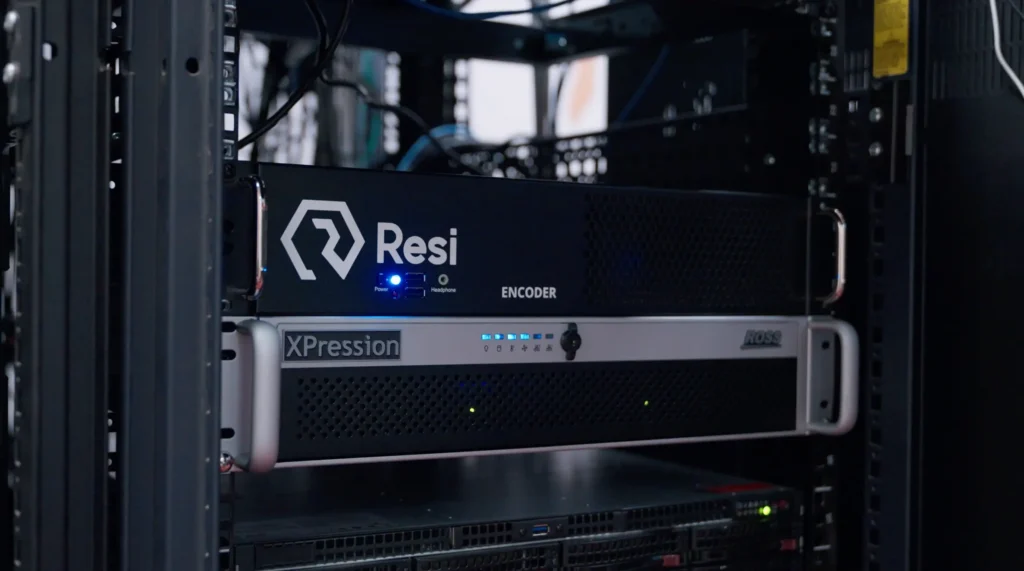
Resi’s role starts with the encoder-to-cloud workflow that gets AVIXA’s signal off the show floor in the first place. “We are partnering with Resi to help encode our live stream and send it out to different destinations on the web,” Metzger said. A travel encoder ships to every show; on-site, it connects to Resi’s cloud platform, which Nara manages through what he calls “a very simple dashboard” — one place to schedule the stream, apply settings, and confirm it’s routing to the right destination.
But the harder problem — the low-bandwidth, high-interference reality of a trade show floor — is where the partnership shows up most. “Since working with [Resi], it’s been a great partnership for us to be able to live stream in complex environments where you might have five megabits or less on the trade show floor,” Metzger said.
That reliability was tested directly at ISE in Barcelona, when AVIXA lost power roughly ten minutes before going live. “Fortunately, we had Steve and Matt and the team on-site to help us get up and live as quickly as possible,” Metzger said. The following year, Resi’s team wasn’t on-site — but the support didn’t stop. “We actually had people waking up in the middle of the night in a WhatsApp group, able to troubleshoot any problems. They were there every step of the way.”
That same responsiveness showed up when AVIXA’s own recording hardware failed mid-show. “We had a show in March where our local media server was having trouble recording the content we were doing on stage,” Metzger said. Because the Resi encoder was already tied into Resi’s cloud platform, the team was able to use the encoder to record straight to Resi’s platform, “even though our [local] hardware wasn’t working. So [Resi] wasn’t just a redundant backup for us — it became our primary source, very quickly.”
For Sam Minish, that kind of support is the reason the partnership has lasted. “We wanted a partner we could be comfortable with, and that’s been the most beneficial thing about our partnership with Resi,” she said. “Being able to say, ‘Hey guys, can you help us troubleshoot this?’ and have them walk through it with us — that’s been huge.” She pointed to one show in particular where the setup ran into problems outside anyone’s control: “They didn’t need to be there the entire time, but they stuck with us and made sure everything was working — that stability, that confidence. They could have easily shown up, set up their stuff, and left. But they stuck with us as we worked through all these different issues.”
The Outcome
The most dramatic test came during a widespread internet outage that, according to Nara, disrupted service across the entire United States during InfoComm. “We had everything set up — the encoders were working perfectly, great video, great audio, everything was going through. But something beyond our control happened,” he said. The Resi and AVIXA team switched to a backup solution and stayed on air through an outage that had nothing to do with their own setup. “That kind of flexibility for us to utilize the [Resi] platform saved the day.”
That same infrastructure is now doing more than covering outages — it’s expanding how far AVIXA TV’s content reaches. Every show broadcast now goes out simultaneously across AVIXA’s website, YouTube, and social channels including LinkedIn, “so that everyone can tune in and see what’s going on,” Nara said. And the studio isn’t limited to trade shows anymore. “Our vision for AVIXA TV is to go beyond the show floor and make it a 365-day channel,” Nara said. AVIXA has built a permanent studio at its Virginia headquarters — wired with its own Resi encoders — so the team can go live year-round, not just from a convention center.
For Matt Morgan, watching that reliability hold up on-site is what makes the partnership work for Ross Video’s side of the build, too. “I wanted to work with really good people who know what they’re doing, and I’ve had great experiences,” he said. “It worked out great to partner with the studio and make sure there was a reliable source that could work on-site and support the team — and make sure that all the viewers had a solid experience, no matter what they were watching from.”
Carey Johnson sums up what that consistency means day to day: “We always know we’re going to get their best. Whether it be technology, customer support, whatever it is — we always know we’re going to get their best.”
Metzger’s advice to any organization facing the same conditions is the simplest distillation of what AVIXA has learned firsthand: “If we can live stream from a trade show floor with very limited bandwidth, and with limitations in terms of lighting and sound control — think of what you could do in a studio environment. If we can do it here, we can do it anywhere.”
Mark Metzger is the Senior Digital Video Manager at AVIXA TV, where Resi powers live streaming from trade show floors around the world to the organization’s year-round studio at its Virginia headquarters.