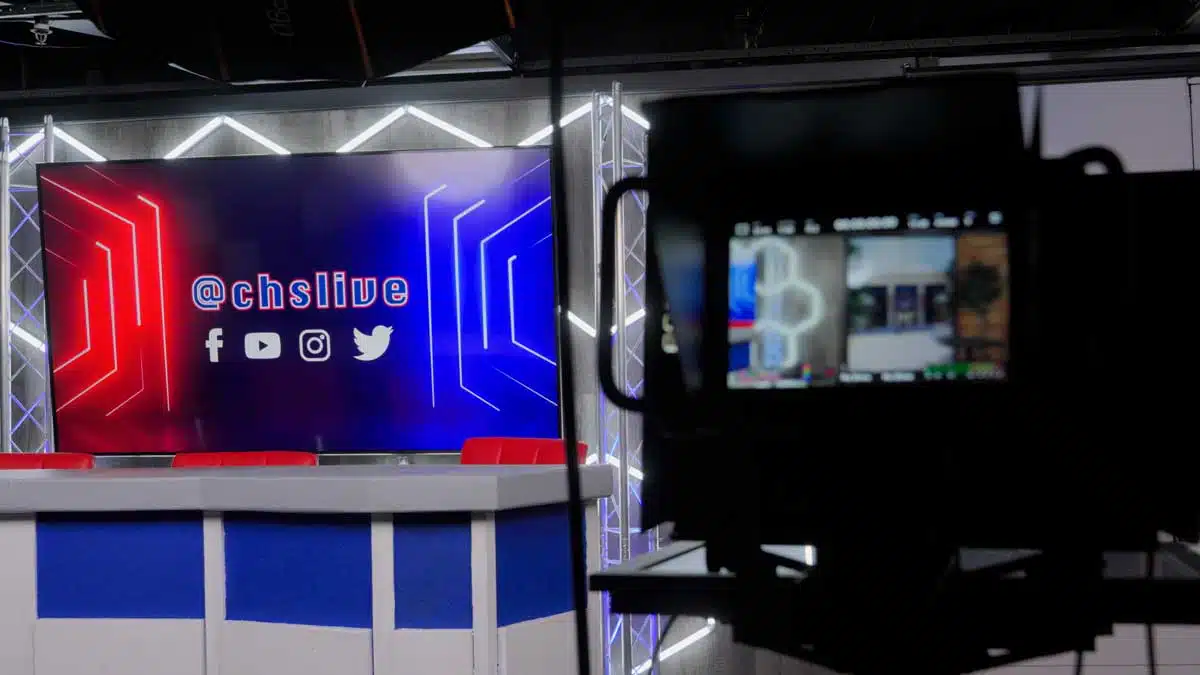
At Cleveland High School in Cleveland, TN, the best lesson a digital media student could get wasn’t in a textbook — it was behind a camera, at a live event.
Learning by Doing
Delano Halfacre — Mr. D to his students — believed there was only one way to truly learn broadcast production: get your hands on the equipment and do it for real.
That conviction shaped everything about Cleveland High School’s digital media program. From the gear they used to the events they covered, every decision Mr. D made came back to a single question: does this put meaningful, real-world experience in students’ hands?
It’s why, when other schools pointed automated cameras at the action to do the work, Cleveland sent students to the field. And it’s why, when a professional sports organization needed someone to produce their live broadcasts, Halfacre’s classroom got the call.
“Don’t take the equipment out of the students’ hands. So many students from this program are doing great things ahead in college because they get hands on all of this.”
For Halfacre, the technology in his program had to do two things at once: deliver professional-quality results and actively involve students in producing them. That was a harder bar to clear than either one alone — and it was what led him to Resi.
Tools That Teach and Perform
When Cleveland moved from Vimeo to Resi, the immediate difference wasn’t just reliability — it was how quickly students could go from learning the system to running it independently.
The hardware setup was straightforward enough that Mr. D could put a new student in front of it and trust the results. Plug in an SDI cable, connect Ethernet, power it on, log in. The encoder told you exactly what it was receiving and whether it was ready to go.
That simplicity wasn’t a compromise — it was a feature. Because once students weren’t wrestling with software settings or troubleshooting laptop compatibility issues, they could focus their energy where it belonged: on the craft of production. Camera angles. Shot composition. Live directing. The work that actually built a career.
And as their confidence grew, so did their autonomy. Mr. D could send a student crew to set up two cameras in the theater for a 6:00 p.m. performance and trust them to handle it — monitoring remotely through the Resi web interface while they ran the show themselves.
“All I’ve got to do is be at home sometimes, start the stream from Resi, and it’s done,” he said. “I’ll wait to see the fade to black, then stop the feed.”

From School Hallways to Professional Sidelines
The real proof of what hands-on learning built was what happened when students left campus.
Three years ago, the Chattanooga Football Club reached out to Cleveland High School looking for someone to produce their live broadcasts — on short notice, with no detailed brief, starting in two weeks. Mr. D said yes. He loaded up a trailer of equipment, drove his students to the stadium, and they figured it out together.
What started as a single engagement grew into an ongoing professional partnership. Each year, the CFC added to the scope: instant replay, multi-camera field coverage, B-roll packages. Cleveland’s student crew traveled to Chattanooga to produce broadcasts that drew thousands of viewers — under contract, for a real client, with real stakes.
“Once they realized what we could actually do, that’s when they started adding on to our plate,” Halfacre said.
The production quality was so high that people on the sidelines sometimes didn’t realize who was running it. Players asked about the video playback. Staff asked who was doing the broadcast that year.
“They’ll say things like, ‘Oh, that’s a high school class doing that?'” Halfacre laughed.
That reaction was exactly the point. The CFC contract wasn’t a field trip — it was a portfolio piece, a professional reference, and a direct line from the classroom to a career. Students who came through Cleveland’s program left with something most of their peers didn’t: Real hours behind professional equipment, on real events, for a paying client.
“When they put that on their résumé, more than likely they can get like 50% of job opportunities somewhere,” Halfacre said. “They want to see if you know how to run cables, you know how to work a camera, you know basic straight equipment.”
One of Mr. D’s students added:
“My favorite part about digital media is just having the hands-on learning experience, especially with live streams. We do CFC — Chattanooga Football Club — and just experiencing that live environment, being able to take the skills I’ve learned in class and put that into an actual project has been really entertaining and fun.”

The Reliability That Made It All Possible
None of it worked without a platform students and instructors could trust under pressure. And with a professional contract on the line, the stakes of a dropped stream were very real.
At the CFC’s venue, network instability was a recurring challenge. On one occasion, a firewall conflict forced the team to switch Ethernet ports mid-event. Thanks to Resi’s Resilient Streaming Protocol and built-in stream delay, the audience watching at home never knew anything happened.
“Because of Resi’s built-in delay, nobody ever knew that we went blank for a while,” Halfacre said. “We just unplugged it, plugged it back in. Resi saved us.”
That same reliability gave Mr. D the confidence to step away from the controls and let his students lead — knowing that if something went sideways, he could monitor and respond remotely without pulling anyone off the field.
“Even if I can’t be there, I can control their stream. I can start it, I can stop it, I can reconnect it if it fails,” he said. “That’s the great thing about Resi — it works for both my students and I.”
What Got Built in the Process
Back at school, the program Cleveland built around Resi spanned nearly every sport, performing arts event, and major campus milestone — close to 500 hours of live streaming in a single school year, run almost entirely by students.
Graduates from the program continued to return and help on larger events. Younger students learned from the ones ahead of them. Mr. D coached from the field while his students directed from the booth.
And somewhere in Minnesota, a grandmother got to watch her grandson play football every Friday night.
“When we don’t live stream, I get a bunch of comments: ‘Hey, why don’t you guys live stream?'” Halfacre said. “These elderly people that can’t leave the house, or if they’re away — all they’ve got to do is just watch us, and it works.”
That community connection, those professional opportunities, those student careers in the making — they all started with the same decision: put the equipment in students’ hands and trust them to do something great with it.

Cleveland High School’s digital media program, led by instructor Delano Halfacre, produced live broadcasts for school athletics, performing arts, campus events, and the Chattanooga Football Club using Resi hardware and software.