Your live stream is an hour long. The moment that will stop someone mid-scroll on Instagram is 47 seconds of it. The teaching clip that would get shared three thousand times on YouTube Shorts is already in your recording — you just haven’t pulled it out yet.
Short-form video doesn’t require producing new content. It requires recognizing the short-form content already inside your long-form content and extracting it deliberately.
Why Short-Form Video Helps You Reach More People
The people who watch YouTube Shorts, Instagram Reels, and TikTok are not the same people who watch your full Sunday service stream. Different platform, different context, different viewer behavior — and critically, different discovery mechanism.
Your stream reaches the people who already know you and choose to tune in. Short-form platforms push your content to people who don’t know you exist. The algorithm on each of these platforms is specifically designed to surface short videos to users who haven’t subscribed — which means a well-cut 60-second clip can reach an audience with no prior connection to your church, school, or organization.
This is the reach equation that makes repurposing worth the effort. The long-form stream serves your existing audience. The short-form clips serve as discovery content for people who haven’t found you yet. The content is already there. The gap is in the workflow for getting it out.
How to Repurpose Live Stream Content for Reels, Shorts, and TikTok
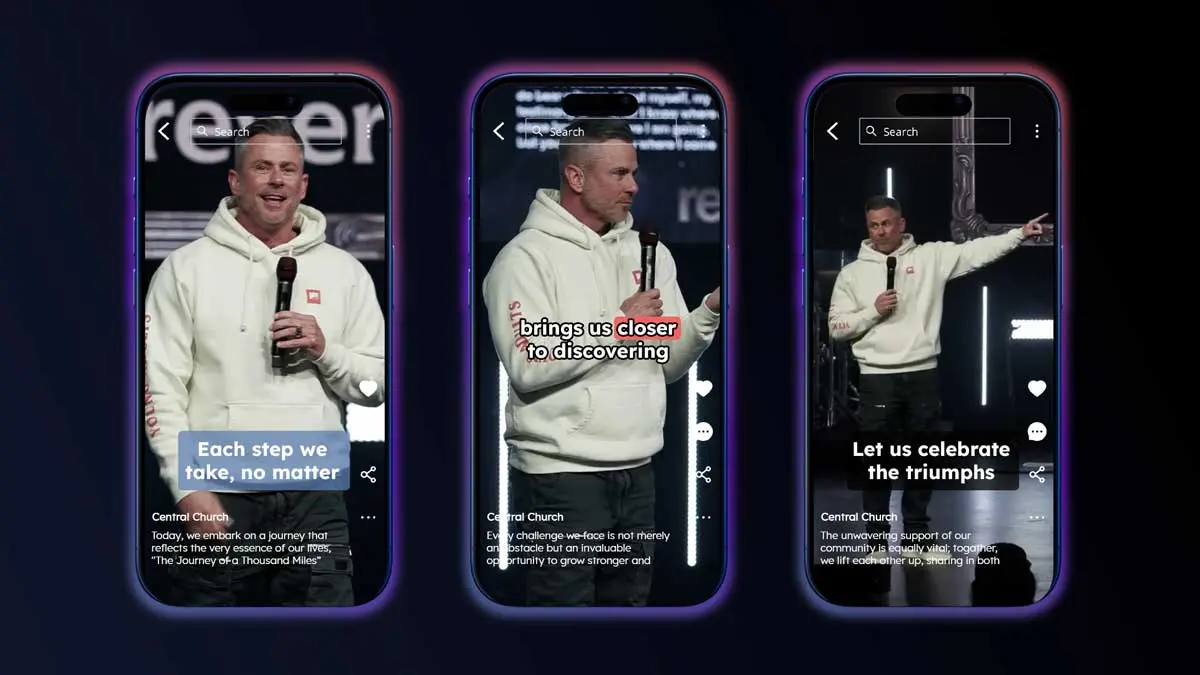
Good short-form clips share a few characteristics: they start strong (the first two seconds determine whether someone keeps scrolling), they’re self-contained (no context required from anything that came before), and they deliver something — a complete thought, a moment of emotion, a surprising statement — within 30 to 90 seconds.
Finding these moments in your stream recording is easier than it sounds. Your analytics are a useful starting signal: the moments where your concurrent viewer count holds steady or ticks upward are the moments worth reviewing. Wherever viewers aren’t leaving is where the content is earning attention.
Look specifically for:
- Moments where the speaker says something unexpected, counterintuitive, or immediately quotable
- Emotional peaks — congregational response, a powerful musical moment, a story that lands visibly
- Teaching content that can stand alone without setup — a principle, a reframe, a memorable illustration
How to repurpose live stream content for YouTube Shorts and TikTok covers the workflow and platform-specific considerations in detail.
Basic platform specs worth knowing: all three major short-form platforms prefer vertical (9:16) aspect ratio content. YouTube Shorts max out at 60 seconds. Instagram Reels can run up to 90 seconds. TikTok allows up to 10 minutes but performs best under 60 seconds in most cases. Captions are non-negotiable — most short-form viewing happens without audio.
How Resi Studio AI Makes Repurposing Faster
The manual version of this workflow — scrubbing through a 60-minute recording to find the three best clips, trimming them, captioning them, and exporting to each platform — takes more time than most small production teams can realistically commit to every week.
Studio AI is built to change that, but it’s not just about speeding up clipping.
Studio AI helps surface the moments that matter, using your existing recordings to identify highlight-worthy segments without requiring someone to sit through the entire video. From there, clips are created directly within your Resi content library, which means no downloading files, no jumping between tools, and no rebuilding work in a separate editor.
That same workflow extends beyond clips. Transcripts track with playback, can be edited for accuracy, and are ready to copy or download for use across other channels. Publishing is built in as well, so getting content out to platforms like Instagram doesn’t require another step or another tool.
This doesn’t replace human judgment. Someone still needs to review what surfaces, refine it, and decide what actually gets published. But it removes the most time-intensive parts of the process: searching, scrubbing, organizing, and preparing content for reuse.
For a church or school with a small team, that shift matters. It turns content repurposing from something that feels optional or inconsistent into something that can actually happen on a regular basis, without adding more weight to an already full week.
Building a Repeatable Short-Form Content Workflow
Consistency matters more than perfection in short-form content. One clip published every week, reliably, accumulates more reach over time than an occasional high-production clip released when the stars align.
The workflow that works for most teams is simple: after each stream, one person — a staff member, a regular volunteer, anyone who watches the stream anyway — flags two or three timestamp moments that felt worth clipping. That list goes to whoever handles the cut. The cut gets captioned. It gets published to each platform with a short caption. Done.
Captions are worth emphasizing again. Automated subtitles generate for your stream recording automatically, which gives you a captioned version to work from without a manual transcription step. Most short-form content creation tools can pull from an existing caption file.
For teams building toward a broader content strategy, live streaming in modern brand storytelling covers how short-form video fits into the larger picture of how organizations build an audience online.
The content is already there. It’s in every recording you’ve ever streamed. The question is whether you have a workflow to get it out.