Most streaming setups get built piece by piece. You pick a camera, find an encoder that fits the budget, and choose a platform that seems to work. Then you bolt them together and hope for the best. For a lot of organizations, that works well enough — until a Sunday morning when it doesn’t.
The decision most teams never question is whether their encoder and streaming protocol were designed to work together. They weren’t chosen as a system. They were chosen as separate line items. And that gap is exactly where streams fail.
Why Hardware and Software Integration Matters for Streaming Reliability
An encoder takes the signal from your camera, compresses it, and sends it out over the internet. A protocol sends that compressed data from your encoder to your viewers’ screens.
In practice, those two jobs are deeply intertwined. When the network drops a packet — and it will — something has to decide what happens next. Does the stream pause? Does it freeze? Does it skip? Does it self-correct and keep going without the viewer ever noticing?
The answer depends entirely on whether your encoder and protocol are speaking the same language.
With most off-the-shelf encoders using RTMP, the answer is: it pauses. It freezes. It buffers. RTMP was designed in an era of relatively stable broadband connections, and it handles packet loss by stopping and waiting. That’s not a bug in your setup — it’s how the protocol was built. It just wasn’t built for what you’re asking it to do.
When encoder firmware and protocol are co-developed, the calculus changes. Both sides of the equation know what the other is doing, which means they can share a recovery strategy instead of each one shrugging and waiting for the other to figure it out.
What You Get When Your Encoder and Protocol Are Built to Work Together
RSP — Resi’s Resilient Streaming Protocol — was built around a simple premise: take advantage of a short delay to make sure perfect content reaches the cloud before your viewers ever see it. When packets go missing in transit, RSP retransmits them. The encoder knows to hold that buffer. The protocol knows to request the missing data. The viewer sees nothing.
That’s not possible when you take an RTMP-based hardware encoder and swap in a resilient protocol as an afterthought. The encoder doesn’t know how to hold a buffer for retransmission. The protocol can ask for missing packets, but if the encoder has already moved on, there’s nothing to send.
Resi hardware is built to run RSP natively. The encoder firmware and the protocol are developed together, which means the encoder’s buffer management, retransmission logic, and error correction all work in concert with how RSP moves data through the cloud. You can lose internet for up to 10 minutes and your viewers won’t see a single frame drop. When the connection comes back, the encoder picks up exactly where it left off and sends the buffered data forward.
This matters most in the moments you can least afford a failure: the altar call, the keynote speaker, the graduation ceremony, the board vote. These aren’t moments where “mostly reliable” is good enough.
What to Look for in a Live Stream Encoder That Won’t Let You Down
Not every encoder is built with mission-critical reliability in mind. Some are built for price. Some for portability. Some for feature counts on a spec sheet. The ones worth depending on share a few characteristics.
Dedicated processing. A purpose-built encoder handles one job — encoding — without competing with other applications for CPU cycles. A laptop running streaming software is also running your slide deck, your browser, your email client, and occasionally a system update. A computer runs multiple applications competing for resources. A dedicated encoder just encodes.
Thermal management. Most consumer and prosumer hardware is designed for intermittent use. A worship service, a board meeting, or an all-day conference runs for hours under sustained load. Hardware that throttles under heat will degrade mid-stream, and it will do it at the worst possible time.
Network redundancy. The best encoders don’t assume the network will behave. They assume it won’t, and they build accordingly. That means buffering, retransmission capability, and the ability to resume a stream after a connection interruption rather than forcing a manual restart.
Protocol compatibility. If you’re running RSP, your encoder needs to be built for RSP. Not adapted for it. Not close enough. Built for it.
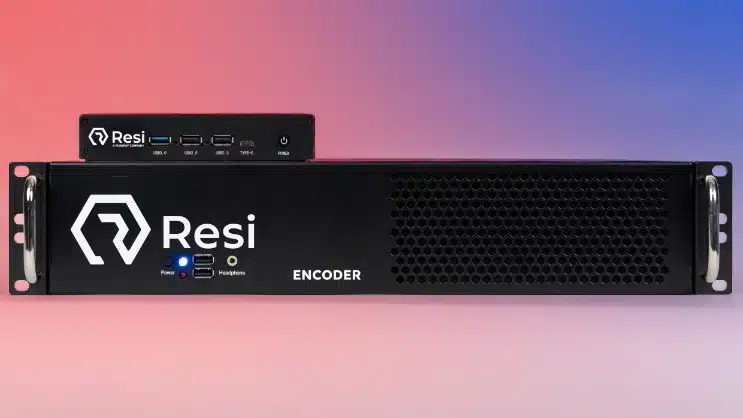
The Resi Mini Encoder is the primary recommendation for most use cases — compact, reliable, and purpose-built to run RSP. For high-demand environments, multi-channel setups, or 4K production, Resi’s Server-Grade Encoders handles the load without breaking a sweat.
The Real Cost of a Mismatched Streaming Stack
There’s a common assumption that a failed stream is just an inconvenience. Viewers will wait. They’ll refresh. They’ll come back next week.
The data says otherwise. A single failed stream carries real costs — viewer attrition, damaged trust, staff time spent troubleshooting instead of moving forward, and the compounding effect of an audience that learns not to rely on your stream.
The issue isn’t budget. You can spend a lot of money on a streaming stack that’s still mismatched. A high-end encoder running RTMP will still freeze when the network hiccups. A resilient protocol bolted onto hardware that wasn’t designed for it will still drop frames when the encoder can’t deliver what the protocol needs.
The fix isn’t spending more. It’s spending on the right things — a hardware encoder and protocol designed to work as a system, not assembled from separate decisions made at separate times.
When the two halves of your streaming stack are built for each other, failure is taken out of the equation because it hasn’t happened. That’s the version of “reliable” that actually earns the word.